

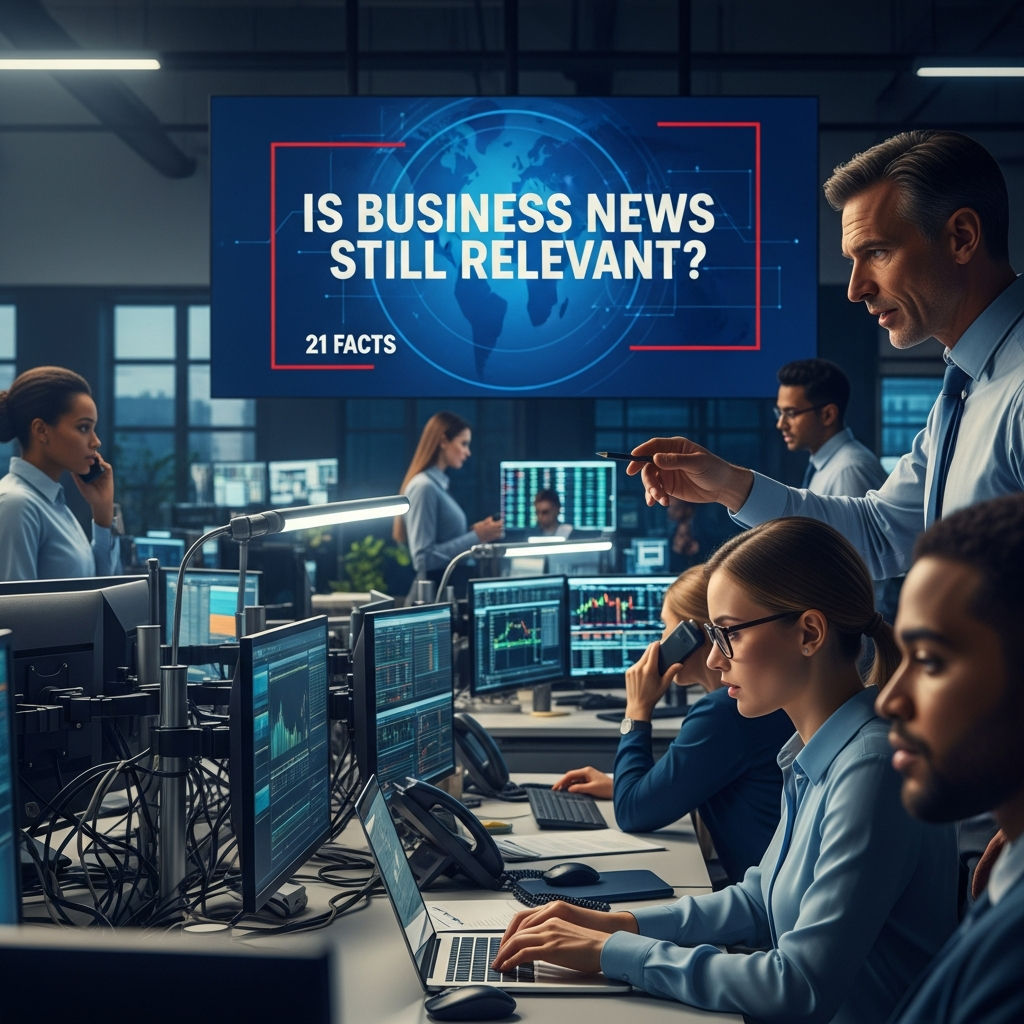
Is Business News Still Relevant? 21 Facts About the Evolution of Financial Information
In an era defined by 15-second viral videos and an overwhelming influx of social media notifications, the traditional concept of “business news” has faced intense scrutiny. Critics argue that by the time a story hits a major publication, the market has already reacted, making the information obsolete. However, for investors, entrepreneurs, and career-minded professionals, business news remains the heartbeat of the global economy.
The relevance of business news hasn’t diminished; rather, its form has mutated. We have moved from the era of the morning paper to an era of real-time data streams, deep-dive newsletters, and algorithmic sentiment analysis. To understand why staying informed is more critical now than ever, we must look at how information dictates the flow of capital and the direction of innovation.
The Changing Landscape of Financial Media
Historically, business news was a gatekept commodity. If you wanted to know how the markets were performing or which companies were merging, you needed a subscription to the Wall Street Journal or a Bloomberg Terminal. Today, democratization has occurred. While high-level data still carries a price tag, the fundamental narratives driving the economy are accessible to anyone with an internet connection.
This accessibility has created a “signal vs. noise” problem. The relevance of business news today lies in the ability to filter through the noise to find actionable insights. It is no longer just about knowing *what* happened, but understanding *why* it happened and what the second-order effects will be on your portfolio or career.
21 Facts About the Relevance of Business News Today
1. Market Volatility is Driven by Breaking Headlines
In the age of high-frequency trading, news breaks can trigger thousands of trades in milliseconds. Whether it’s an unexpected inflation report or a geopolitical conflict, business news is the primary catalyst for market movement.
2. Quarterly Earnings Reports Dictate Stock Valuation
Business news outlets remain the primary source for dissecting quarterly earnings. These reports are the “report cards” of the corporate world, and the analysis provided by journalists helps retail investors understand the health of a company beyond the raw numbers.
3. Information is a Risk Mitigation Tool
For business owners, staying updated on supply chain disruptions or changes in trade policy is essential for risk management. Business news acts as an early warning system for potential operational hurdles.
4. The Rise of “Niche” Business News
General business news is being supplemented by hyper-specific reporting. Verticals dedicated to SaaS, FinTech, Green Energy, and AI provide deep-domain expertise that is highly relevant to professionals in those specific sectors.
5. Economic Indicators Influence Personal Finance
Business news translates complex data—like the Consumer Price Index (CPI) or Federal Reserve interest rate hikes—into practical information. This helps individuals make decisions about mortgages, car loans, and savings accounts.
6. M&A Activity Shapes Industry Landscapes
Mergers and acquisitions (M&A) news reveals where the big players are placing their bets. Understanding these moves helps competitors and observers predict the future direction of an entire industry.
7. ESG Reporting is Now Mainstream
Environmental, Social, and Governance (ESG) criteria are now a major part of business news. Investors increasingly use this news to align their portfolios with their values, making ethical reporting more relevant than ever.
8. Career Advancement Requires “Business Literacy”
Professionals who stay informed about their industry’s news are better equipped for promotions and salary negotiations. Knowledge of market trends allows employees to position themselves as strategic assets to their companies.
9. Social Media is a Double-Edged Sword
While platforms like X (formerly Twitter) provide instant news, they also spread misinformation. Traditional business news outlets act as “verifiers” in an ecosystem often cluttered with unverified rumors.
10. The “Newsletter Renaissance”
The success of business newsletters like Morning Brew or The Hustle proves that there is a massive appetite for curated, personality-driven business news among younger demographics.
11. Real-Time Data vs. Long-Form Analysis
While real-time alerts are great for traders, long-form investigative business journalism provides the context necessary for long-term strategic planning. Both remain equally relevant for different purposes.
12. Business News Influences Consumer Behavior
News regarding data breaches, corporate scandals, or product launches directly impacts consumer trust and spending habits. Companies monitor business news as a form of reputation management.
13. The Impact of Geopolitics on Trade
In a globalized economy, a political decision in one country can affect a factory in another. Business news bridges the gap between international relations and local commerce.
14. Demographic Shifts are Documented by Business Media
Reporting on the “Great Resignation” or the shift toward remote work has allowed companies to adapt their HR strategies based on broader economic trends documented by journalists.
15. Technological Innovation News is Business News
The line between “tech news” and “business news” has blurred. Updates on AI developments are, at their core, stories about productivity, capital investment, and future labor markets.
16. Cryptocurrency and De-Fi Integration
As digital assets become part of institutional portfolios, business news has evolved to include comprehensive coverage of the crypto landscape, providing legitimacy to a once-fringe market.
17. Regulatory Changes and Compliance
Governments worldwide are constantly updating tax laws and antitrust regulations. Business news is the most efficient way for companies to stay compliant and avoid massive fines.
18. Startup Ecosystem Transparency
Business news provides a platform for startups to gain visibility. Coverage of venture capital (VC) funding rounds helps connect innovators with potential partners and talent.
19. The Role of Data Journalism
Modern business news often utilizes data visualization to make complex economic trends understandable. This “democratization of data” allows non-experts to grasp sophisticated financial concepts.
20. Sentiment Analysis for Investors
Hedge funds and institutional investors use natural language processing (NLP) to “read” business news headlines and gauge market sentiment, proving that the *text* of news has direct monetary value.
21. Historical Record and Accountability
Business news serves as a historical record of corporate conduct. Investigative pieces often uncover fraud or mismanagement (like the Enron or Theranos scandals), holding powerful entities accountable.
Why Business News is the Backbone of Strategic Thinking
Strategy is essentially the act of making a bet on the future. Without business news, those bets are based on intuition rather than evidence. By following market trends, an entrepreneur can spot a “gap” in the market before it becomes obvious to everyone else. For example, those who followed the news regarding early cloud computing shifts were able to pivot their businesses a decade before the “digital transformation” craze became a corporate buzzword.
Furthermore, business news fosters a global perspective. In today’s economy, isolationism is a recipe for failure. Understanding how a drought in Brazil affects coffee prices in New York, or how a semiconductor shortage in Taiwan impacts car dealerships in Germany, is only possible through consistent consumption of high-quality business journalism.
The Challenges of Modern Business Journalism
While business news remains relevant, it does face significant challenges. The “paywall” problem is perhaps the most prominent. Many of the world’s most reputable sources (The Financial Times, Bloomberg, etc.) require expensive subscriptions. This creates an information asymmetry where those who can afford the news have a distinct advantage over those who cannot.
Additionally, the speed of the 24-hour news cycle often prioritizes “being first” over “being right.” This can lead to reactionary reporting that misses the nuance of a situation. Users must be discerning, looking for outlets that prioritize accuracy and deep analysis over clickbait headlines.
Conclusion: The Future of Staying Informed
Is business news still relevant? The answer is a resounding yes. However, its relevance is no longer passive. In the past, you could simply read the paper and feel “informed.” Today, relevance is active. It requires the reader to synthesize information from various sources—newsletters, podcasts, traditional outlets, and data feeds—to build a comprehensive worldview.
As long as there is trade, innovation, and competition, there will be a need for business news. It remains the most powerful tool for anyone looking to navigate the complexities of the modern world, manage their wealth, and build a resilient career. In the information age, the most valuable currency isn’t just money—it’s the insight derived from knowing what is happening in the world of business before everyone else does.